MiniVibe helps children aged 3–6 start speaking in real sentences through emotions, stories, repetition, and play at home, without classrooms or stress.
But struggle to use them in real situations.
But rarely create sentences on their own.
But freeze when it's time to speak.
Without gaining confidence communicating.
The gap between knowing words and speaking confidently is where many children get stuck. MiniVibe fills this gap.
MiniVibe is not a traditional English course. It is a structured speaking system designed to help children actually use English in real situations.
Children learn language faster when words are part of a story, not isolated vocabulary.
Children stay engaged because they follow familiar characters across lessons.
Every lesson includes pauses where children are expected to respond out loud.
Key phrases return across lessons until children naturally start forming sentences.
Children remember language better when it is connected to feelings like happy, sad, angry.
Simple songs help reinforce sentence patterns without memorization.
Surprise effects keep attention high and create strong memory points during lessons.
Simple homework extends learning into daily life so progress continues off-screen.
Not just repeating words — but actually communicating.
The goal is not perfect English. The goal is a child who can express themselves confidently.
Traditional English lessons were never designed for how young children actually learn to communicate. MiniVibe removes the biggest barriers that slow children down.
No need to match school timetables or tutor availability.
Everything happens at home — no wasted time before or after lessons.
Children can pause, repeat, and return to lessons until they truly understand.
Unlike live lessons that depend on the teacher's energy, every MiniVibe lesson is carefully prepared and delivered the same way every time.
No need for extra tutors, apps, or materials — everything is already structured in one place.
You don't need teaching experience — the system guides everything and tells you what to do to help your child learn faster.
Every child can learn words. Not every child learns how to express themselves. MiniVibe was designed to bridge that gap.
Structured cartoon-style lessons where children learn English through stories instead of isolated words.
Each lesson includes moments where your child is asked to respond out loud — not just watch passively.
When children hear a word, they immediately see its meaning on screen (e.g. "apple" → image appears instantly), helping them understand and remember faster.
Your child learns how to name and express emotions like happy, sad, angry using simple English in real situations.
Important words and phrases naturally repeat across lessons so your child slowly starts using them without memorizing.
Songs, characters, stories, and simple surprise moments keep children focused and emotionally engaged throughout learning.
Clear guidance so you always know how to support your child at home without needing teaching experience.
Instead of searching for lessons, activities, worksheets, videos, and games separately… everything is already organized in one place.
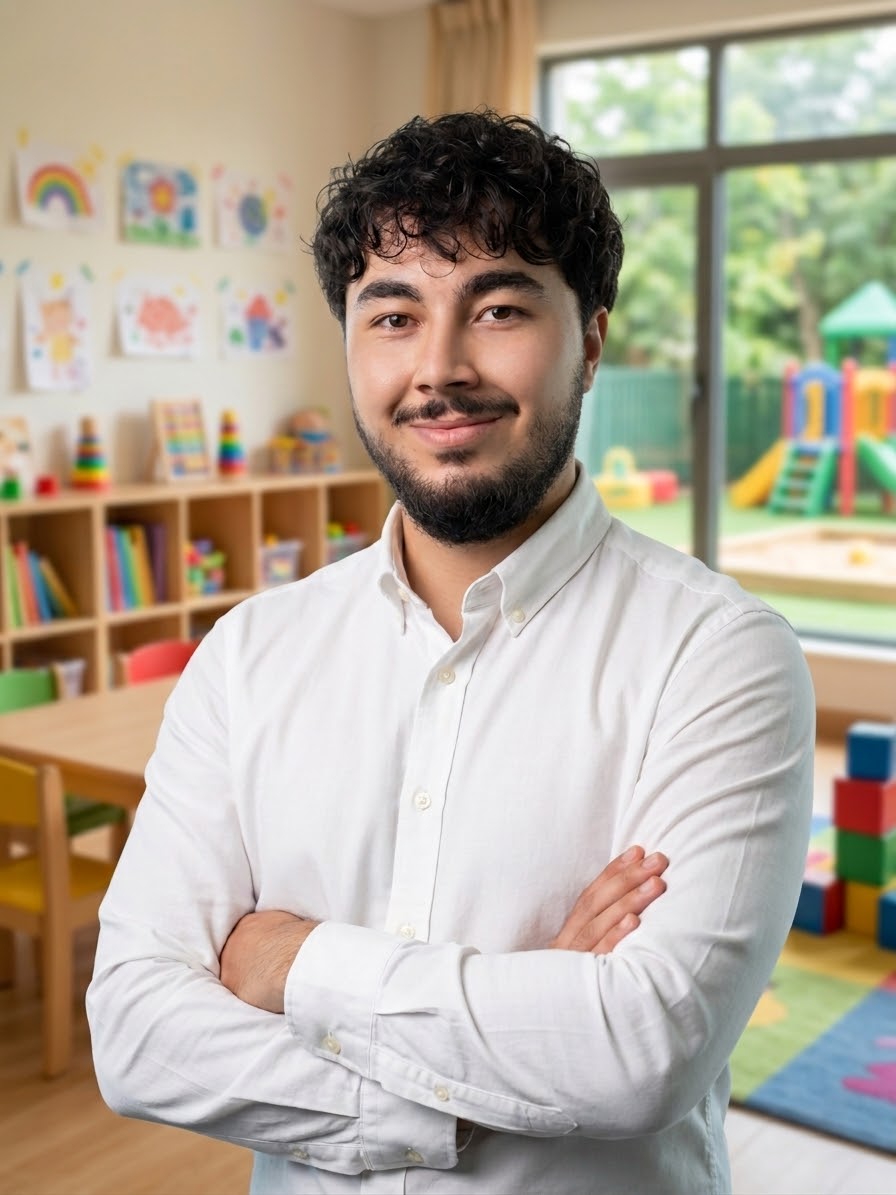
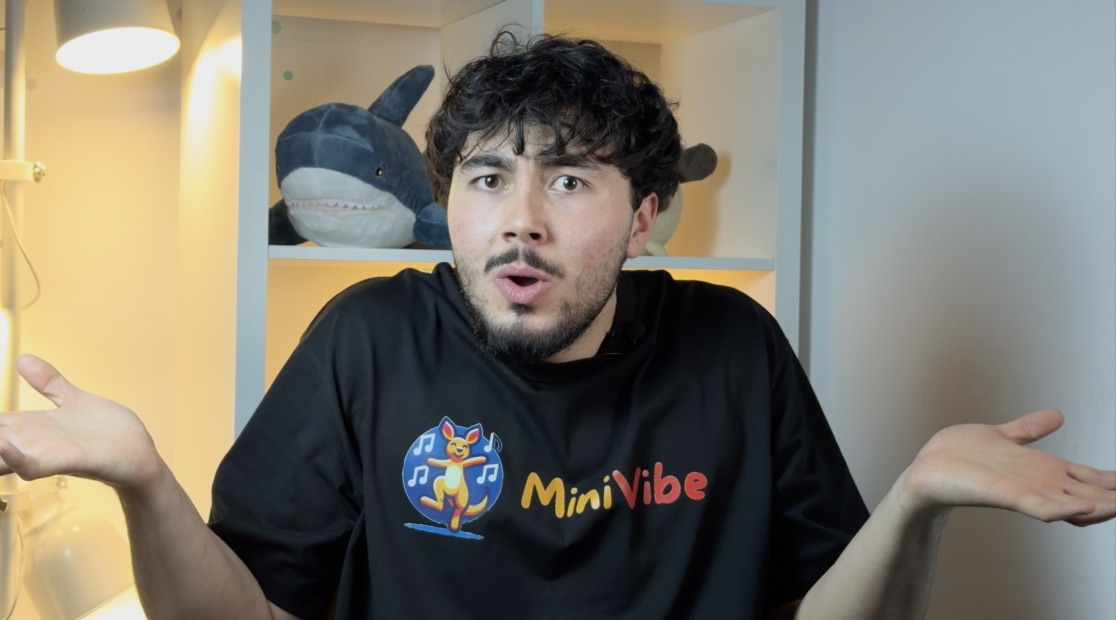
I'm not a former teacher who moved online. I teach English to preschool children in a Warsaw kindergarten every week, and I still do. Six years in, I kept seeing the same thing: children knew the words — say "apple" and they'd point at the apple — but ask them how they felt, and they went quiet. They had vocabulary. They didn't have a voice.
I also noticed something nobody was teaching: children feel happy, sad, angry and scared all day long, and no one gives them the English to say it.
So I built MiniVibe from what actually works in my classroom. Every story, every song, every pause where a child is asked to answer out loud — it was tested on real children first. If an activity failed with my class, it never made it into the course. This isn't theory. It's my Tuesday morning.
MiniVibe is new — the first families are only just starting, so I am not going to invent course reviews. But I have taught children for six years. Here is what parents have written to me about my work with their child.
Quotes are translated from the parents' original Polish emails. You can open each original message under the quote.
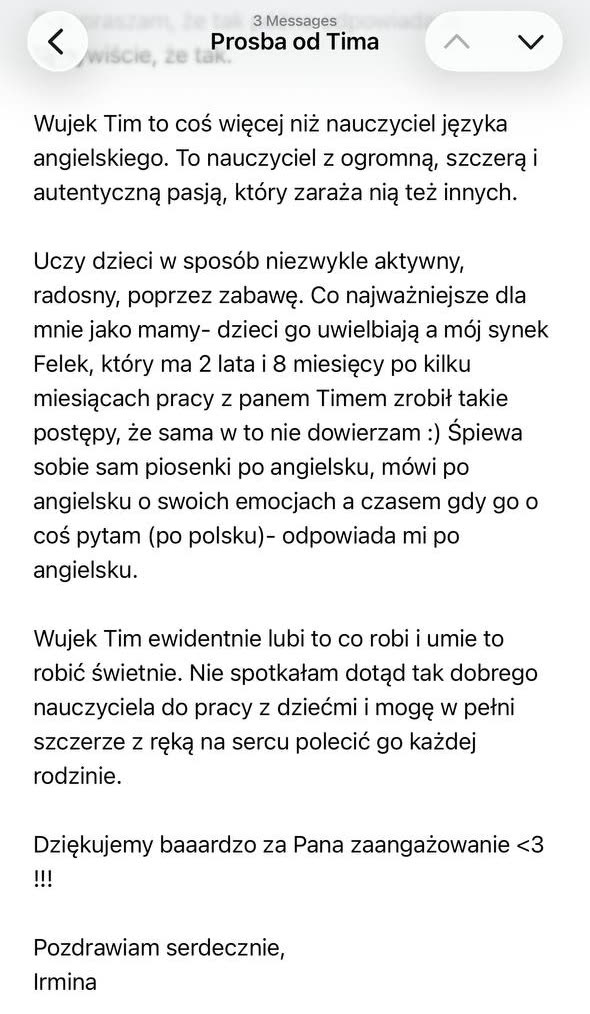
My little boy Felek, who is 2 years and 8 months old, made such progress after a few months with Mr Tim that I can hardly believe it myself :) He sings English songs to himself, talks about his emotions in English, and sometimes when I ask him something in Polish, he answers me in English.
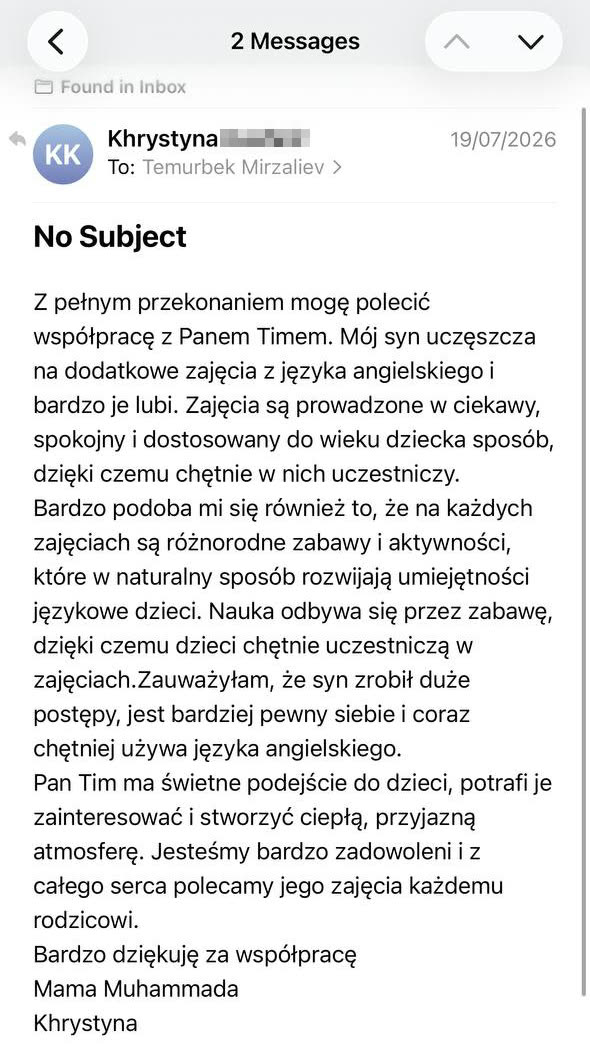
The lessons are interesting, calm and matched to a child's age, which is why he takes part so willingly. I have noticed that my son has made great progress — he is more confident and uses English more and more willingly.
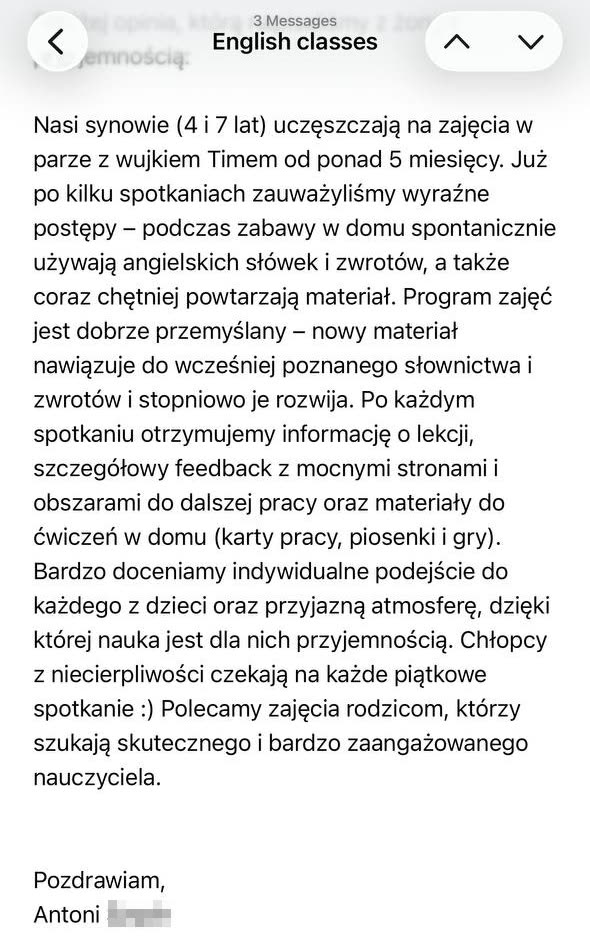
After only a few sessions we noticed clear progress — while playing at home they spontaneously use English words and phrases. The boys can hardly wait for every Friday session :)
These are reviews of my work with children, not of the course. Reviews of MiniVibe itself will appear here when the first families finish it — and every one of them will be real and verified.
MiniVibe is designed for children aged 3–6 who are starting or developing their English speaking skills.
No. The program is designed for beginners and children who already know some words but struggle to speak.
Each lesson is around 20–30 minutes, designed to keep children engaged without overwhelming them.
No teaching experience needed. The system guides every step and tells you exactly how to support your child.
Yes. Repetition is encouraged. Children often learn best by revisiting content multiple times.
Most families use it a few times per week, but you can adjust it based on your child's routine.
No. Children also learn how to express emotions like happiness, sadness, and anger through simple English communication.
Phone, tablet, laptop, or TV — anywhere your child feels comfortable learning.
Faster than you'd expect for the first small win. Most children say their first full English sentence — usually "I am happy" — during Lesson 1 or 2. That first sentence is the whole point: it proves to your child that they can.
Speaking fluently takes months, and any course promising otherwise isn't being honest with you. What you'll notice in the first two weeks is different: your child answering instead of going quiet, trying a sentence instead of one word, and using an English phrase at breakfast without being asked.
Confidence comes first. Fluency follows confidence — never the other way round.
MiniVibe isn't screen time you leave your child alone with — it's 20 minutes of guided time you spend together. You sit beside your child, the story asks a question, and you wait for them to answer. That's closer to reading a book together than to handing over a tablet.
Yes. The lessons carry all the English — you don't need to teach or translate anything. Your job is just to sit with your child and wait during the pauses. If your child can follow along, so can you.
Try the first four lessons. If your child isn't more willing to answer, try a sentence, or use English outside the lesson after 30 days, email minivibeschool@gmail.com and I'll refund you in full — see the guarantee above.
No. YouTube plays passively — MiniVibe is built around structured repetition and speaking pauses where your child is expected to answer out loud. That's the difference between watching a video and practicing a language.
| Cost | What you get | |
|---|---|---|
| Private tutor (3–6 yrs, Warsaw) | 80–120 zł per 30 min | One lesson. Gone when it ends. |
| Language school | 150–250 zł per month | Fixed schedule. Travel. 8-month commitment. |
| Subscription apps | 60–120 zł per month | Stops the day you cancel. |
| MiniVibe | 349 zł once | 12 lessons + materials. Yours forever. Every child in the family. |
Two tutoring sessions cost more than the entire MiniVibe system. And when the tutor leaves, the lesson leaves with them.
Watch the first four lessons with your child. If after 30 days you don't see your child more willing to answer, try a sentence, or use English outside the lesson — email me at minivibeschool@gmail.com and I'll refund you in full.
No forms. No explanation needed. You keep the printable materials.
I'd rather you told me it didn't work for your child than keep your money.
Everything your child needs to start speaking English confidently — organized in one structured system.
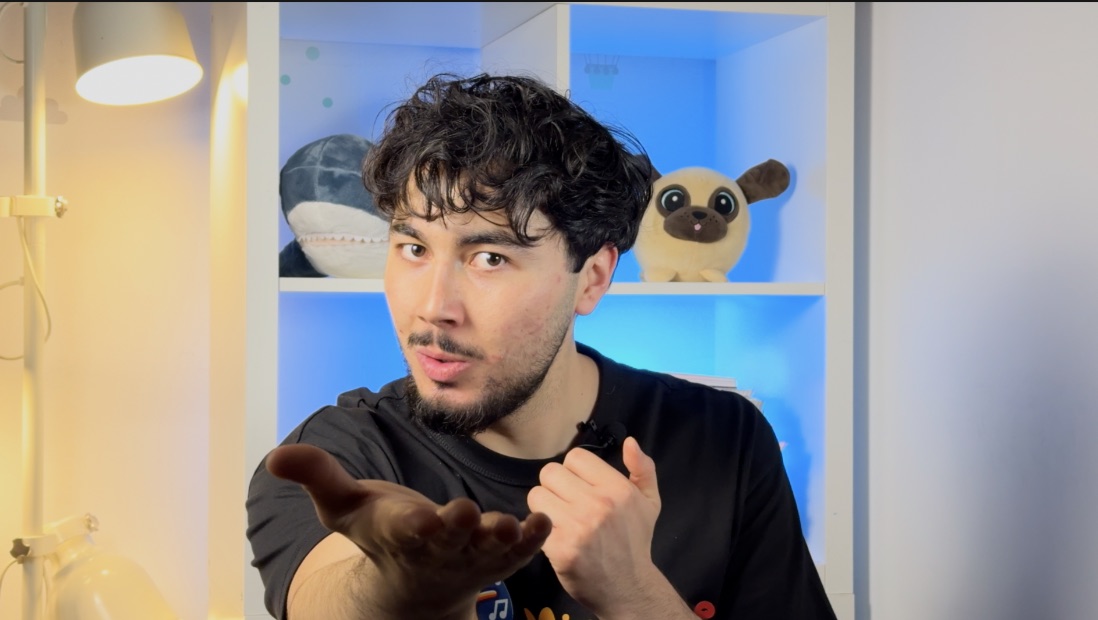
12 video lessons inside
MiniVibe helps children aged 3–6 start speaking in real sentences through emotions, stories, repetition, and play at home, without classrooms or stress.
But struggle to use them in real situations.
But rarely create sentences on their own.
But freeze when it's time to speak.
Without gaining confidence communicating.
The gap between knowing words and speaking confidently is where many children get stuck. MiniVibe fills this gap.
MiniVibe is not a traditional English course. It is a structured speaking system designed to help children actually use English in real situations.
Children learn language faster when words are part of a story, not isolated vocabulary.
Children stay engaged because they follow familiar characters across lessons.
Every lesson includes pauses where children are expected to respond out loud.
Key phrases return across lessons until children naturally start forming sentences.
Children remember language better when it is connected to feelings like happy, sad, angry.
Simple songs help reinforce sentence patterns without memorization.
Surprise effects keep attention high and create strong memory points during lessons.
Simple homework extends learning into daily life so progress continues off-screen.
Not just repeating words — but actually communicating.
The goal is not perfect English. The goal is a child who can express themselves confidently.
Traditional English lessons were never designed for how young children actually learn to communicate. MiniVibe removes the biggest barriers that slow children down.
No need to match school timetables or tutor availability.
Everything happens at home — no wasted time before or after lessons.
Children can pause, repeat, and return to lessons until they truly understand.
Unlike live lessons that depend on the teacher's energy, every MiniVibe lesson is carefully prepared and delivered the same way every time.
No need for extra tutors, apps, or materials — everything is already structured in one place.
You don't need teaching experience — the system guides everything and tells you what to do to help your child learn faster.
Every child can learn words. Not every child learns how to express themselves. MiniVibe was designed to bridge that gap.
Structured cartoon-style lessons where children learn English through stories instead of isolated words.
Each lesson includes moments where your child is asked to respond out loud — not just watch passively.
When children hear a word, they immediately see its meaning on screen (e.g. "apple" → image appears instantly), helping them understand and remember faster.
Your child learns how to name and express emotions like happy, sad, angry using simple English in real situations.
Important words and phrases naturally repeat across lessons so your child slowly starts using them without memorizing.
Songs, characters, stories, and simple surprise moments keep children focused and emotionally engaged throughout learning.
Clear guidance so you always know how to support your child at home without needing teaching experience.
Instead of searching for lessons, activities, worksheets, videos, and games separately… everything is already organized in one place.
I'm not a former teacher who moved online. I teach English to preschool children in a Warsaw kindergarten every week, and I still do. Six years in, I kept seeing the same thing: children knew the words — say "apple" and they'd point at the apple — but ask them how they felt, and they went quiet. They had vocabulary. They didn't have a voice.
I also noticed something nobody was teaching: children feel happy, sad, angry and scared all day long, and no one gives them the English to say it.
So I built MiniVibe from what actually works in my classroom. Every story, every song, every pause where a child is asked to answer out loud — it was tested on real children first. If an activity failed with my class, it never made it into the course. This isn't theory. It's my Tuesday morning.
MiniVibe is new — the first families are only just starting, so I am not going to invent course reviews. But I have taught children for six years. Here is what parents have written to me about my work with their child.
Quotes are translated from the parents' original Polish emails. You can open each original message under the quote.
My little boy Felek, who is 2 years and 8 months old, made such progress after a few months with Mr Tim that I can hardly believe it myself :) He sings English songs to himself, talks about his emotions in English, and sometimes when I ask him something in Polish, he answers me in English.
The lessons are interesting, calm and matched to a child's age, which is why he takes part so willingly. I have noticed that my son has made great progress — he is more confident and uses English more and more willingly.
After only a few sessions we noticed clear progress — while playing at home they spontaneously use English words and phrases. The boys can hardly wait for every Friday session :)
These are reviews of my work with children, not of the course. Reviews of MiniVibe itself will appear here when the first families finish it — and every one of them will be real and verified.
MiniVibe is designed for children aged 3–6 who are starting or developing their English speaking skills.
No. The program is designed for beginners and children who already know some words but struggle to speak.
Each lesson is around 20–30 minutes, designed to keep children engaged without overwhelming them.
No teaching experience needed. The system guides every step and tells you exactly how to support your child.
Yes. Repetition is encouraged. Children often learn best by revisiting content multiple times.
Most families use it a few times per week, but you can adjust it based on your child's routine.
No. Children also learn how to express emotions like happiness, sadness, and anger through simple English communication.
Phone, tablet, laptop, or TV — anywhere your child feels comfortable learning.
Faster than you'd expect for the first small win. Most children say their first full English sentence — usually "I am happy" — during Lesson 1 or 2. That first sentence is the whole point: it proves to your child that they can.
Speaking fluently takes months, and any course promising otherwise isn't being honest with you. What you'll notice in the first two weeks is different: your child answering instead of going quiet, trying a sentence instead of one word, and using an English phrase at breakfast without being asked.
Confidence comes first. Fluency follows confidence — never the other way round.
MiniVibe isn't screen time you leave your child alone with — it's 20 minutes of guided time you spend together. You sit beside your child, the story asks a question, and you wait for them to answer. That's closer to reading a book together than to handing over a tablet.
Yes. The lessons carry all the English — you don't need to teach or translate anything. Your job is just to sit with your child and wait during the pauses. If your child can follow along, so can you.
Try the first four lessons. If your child isn't more willing to answer, try a sentence, or use English outside the lesson after 30 days, email minivibeschool@gmail.com and I'll refund you in full — see the guarantee above.
No. YouTube plays passively — MiniVibe is built around structured repetition and speaking pauses where your child is expected to answer out loud. That's the difference between watching a video and practicing a language.
Two tutoring sessions cost more than the entire MiniVibe system. And when the tutor leaves, the lesson leaves with them.
Watch the first four lessons with your child. If after 30 days you don't see your child more willing to answer, try a sentence, or use English outside the lesson — email me at minivibeschool@gmail.com and I'll refund you in full.
No forms. No explanation needed. You keep the printable materials.
I'd rather you told me it didn't work for your child than keep your money.
Everything your child needs to start speaking English confidently — organized in one structured system.